

Thought Leadership
May 17, 2026
Books without Barriers

# Accessibility
# Ally
Extraordinary Measures: Disability in Music

Katie Grennell, PhD.
Books without Barriers: Extraordinary Measures
What counts as “extraordinary” in music, and who decides?
This blog post in the Books without Barriers series explores Joseph Strauss’s Extraordinary Measures: Disability in Music. Before discovering disability studies, I was fully engrossed in the history of American popular music and planned to become a music history professor. One of the benefits of an interdisciplinary program like American Studies was the freedom to shape my own focus. When I encountered disability studies, I decided to “make fetch happen” and combine my passions for history, music, and disability. I was pleasantly surprised to learn that this wasn’t just a niche intersection, but a subfield with a rich scholarly history and a deeply engaged community. Scholars like Neil Lerner, Alex Lubet, Blake Howe, and Joseph Strauss have helped establish music and disability studies as a dynamic field, examining everything from representation to performance and lived experience. Strauss’s Extraordinary Measures fits squarely within this conversation, offering a framework for understanding how disability reshapes our understanding of virtuosity and the assumptions embedded in musical culture.
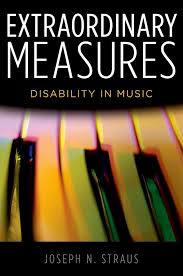
Returning to our introductory question, Extraordinary Measures invites us to rethink what we label as “extraordinary” in music and the assumptions behind that label. In Western classical traditions especially, virtuosity is frequently tied to speed, precision, endurance, and a kind of physical mastery that assumes a particular kind of body and mind. Through a disability studies lens, these standards are not neutral, they are constructed, and they exclude as much as they define.
The book itself reflects that sense of community: it’s an edited collection, with individual chapters contributed by different scholars, each offering their own perspective on music and disability. The collection tends to focus on cases where disability is more directly explored in relation to musical structure, performance, or identity (like Beethoven’s deafness or Evelyn Glennie’s deafness as a percussionist). Julie Andrews’s vocal injury (loss of her singing voice after surgery) can be read through a disability lens, but she’s not typically a central figure in music & disability scholarship in the same way.
Strauss’s chapter on Beethoven is a clear example of how the “overcoming” narrative shows up in music. Beethoven’s deafness is often framed as something he heroically overcame to achieve greatness, reinforcing the idea that disability has to be conquered in order to create “extraordinary” art. Strauss pushes us to look at that story differently. Instead of focusing on how Beethoven succeeded despite being deaf, he asks us to consider how deafness shaped his music—his creative decisions, his relationship to sound, and how his work has been understood over time. In doing so, he shifts focus away from disability as an obstacle and toward its role in shaping musical meaning.
Music, in this context, becomes more than an art form. It is a reflection of broader cultural values, carrying with it assumptions about bodies, ability, discipline, and excellence. The tropes we attach to musicians, like the virtuoso, the prodigy, the figure who overcomes adversity, are not neutral; they are deeply rooted in historical and social frameworks that privilege certain experiences over others. For me, this is part of a broader commitment to teaching accessible history—using music as a lens to explore how narratives are constructed, sustained, and embedded in society, policy, and cultural norms. There is something deeply rewarding in dissecting and deconstructing these stories, revealing what they expose and obscure, and teaching others to recognize and challenge those patterns in their own learning.
By contrast, Extraordinary Measures encourages a different perspective. Instead of asking how someone succeeds despite disability, it asks what assumptions make that success seem extraordinary in the first place—what standards we are using, and whose bodies and minds they assume.
For those of us working in accessibility and content, that shift is essential. It challenges us to look beyond individual effort and toward the systems that define participation and value. In that sense, Extraordinary Measures both fits within and expands the Books Without Barriers conversation, reminding us that accessibility is not only about inclusion, but about rethinking the assumptions that make inclusion necessary at all.
Comment (1)
Popular

Dive in