

Thought Leadership
May 29, 2026
Books without Barriers

# Accessibility
# Ally
Advancing Accessibility

Katie Grennell, PhD.
Books without Barriers: Advancing Accessibility
In this installment of Books Without Barriers, we’re highlighting a resource that’s both practical and deeply grounded in the realities of today’s teaching and design environments: Advancing Accessibility: Practical Strategies for Instructional Designers and Educators.
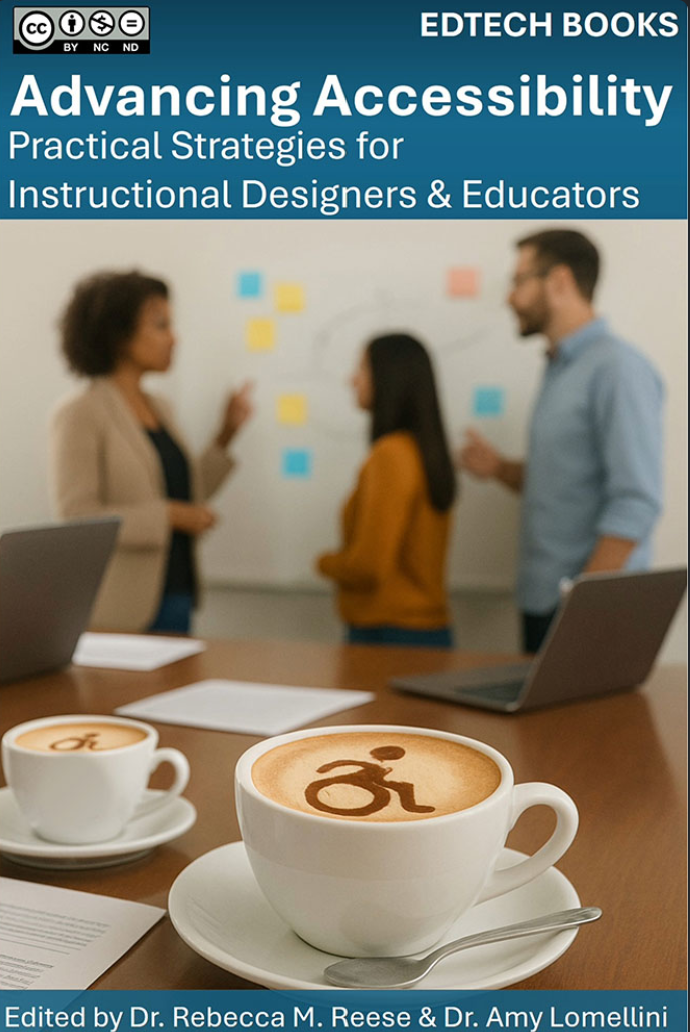
At a time when accessibility expectations are rapidly evolving, across WCAG updates and Title II, the European Accessibility Act (EAA), emerging technologies like AI and immersive tools, and a growing landscape of global regulations, the need for clear, actionable guidance has never been greater. This is especially true for instructional designers, EdTech practitioners, faculty developers, and educators working to create inclusive digital learning experiences.
I’ll admit a bit of bias here seeing as Blackboard’s own Director of Accessibility and my dear friend, Dr. Amy Lomellini, is one of the editors. But that connection is also part of what makes this book stand out. Amy is not only a colleague, but a widely respected voice in the accessibility space, and that expertise shines clearly in the work. She is joined by the equally wonderful Dr. Rebecca Reese, a thoughtful and highly experienced voice in the field.
Accessibility can sometimes feel overwhelming, especially as expectations expand across new modalities, platforms, and technologies. When guidelines feel abstract or disconnected from day-to-day workflows, it can be difficult to know where to begin. What Advancing Accessibility does particularly well is bridge that gap. It’s not just about the why of accessibility, but the how, which is made even more impactful through the volume’s practical approach and clear, accessible language.
This is a book grounded in practice, but also firmly oriented toward the present and future of digital learning. It brings together perspectives from across the field to offer strategies that can be applied in real courses, real content, and real institutional contexts, whether working with traditional course design, multimodal instruction, or emerging technologies.
One of the strengths of Advancing Accessibility is how it moves beyond theory into real-world application. Across the book, contributors show how accessibility takes shape in everyday decisions, from course design to faculty development, and in the tools and technologies that increasingly define modern learning environments.
For example, a chapter on centering accessibility and Universal Design for Learning (UDL) in faculty development highlights how accessibility is most effective when built into course design from the start, not treated as an add-on. This becomes even more critical as courses incorporate a wider range of formats and technologies. In this approach, accessibility considerations are woven into everything from learning objectives to assessments and engagement strategies, helping reduce barriers before they appear.
Another valuable contribution focuses on practical tools and frameworks that instructional designers can use in their day-to-day work, such as frameworks, matrices, and structured design approaches. These resources help educators move from intention to action, whether that’s ensuring course materials are perceivable and usable across platforms, aligning with evolving standards, or validating that accessibility has been considered throughout the design process.
What stands out across these chapters is a consistent theme: accessibility isn’t a one-time task or a final review step, it’s an ongoing, integrated practice. This is especially important in a landscape shaped by continuous change, where new technologies and regulatory expectations require flexibility and sustained attention. By embedding accessibility into design decisions early and often, educators and instructional designers can create learning experiences that are more adaptable, inclusive, and effective for all learners.
At its core, this book aligns closely with what we see every day in the Ally community: accessibility is strongest when it’s intentional, informed, and shaped by the people doing the work. In a field that continues to evolve technologically, pedagogically, and legally, resources like this help make that work more approachable, actionable, and sustainable.
If you’re looking for something that moves beyond theory and helps you take the next step, whether you're responding to new standards, exploring emerging technologies, or refining your practice, this is a worthwhile addition to your shelf.
Comments (0)
Popular

Popular
Dive in