
Innovative Educator Series - The One Where AI supports Learning
The One Where AI supports Learning
This session explores how AI tools in Blackboard — including the AI Design Assistant, Anthology Virtual Assistant (AVA), and conversational AI are shaping course design, student support, and assessment.
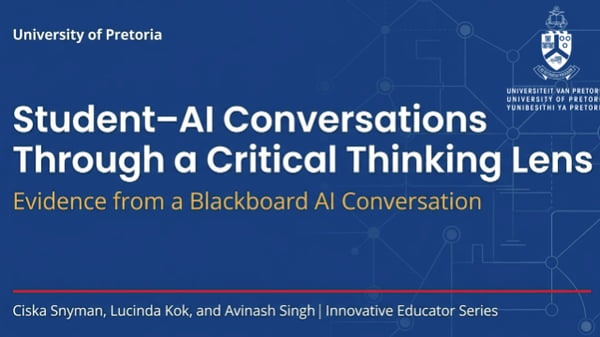
Student–AI Conversations Through a Critical Thinking Lens
University of Pretoria
- Ciska Snyman, Senior Instructional Designer
- Lucinda Kok - Lecturer in Private Law
- Avinash Singh - Lecturer in Computer Science
Critical thinking is a core skill in higher education, yet it often remains hidden in students’ thought processes rather than visible in their work. This session explores how student–AI conversations in clickUP Ultra (Blackboard Ultra) can make these processes observable and provide educators with new ways to support learning. Drawing on evidence from a second-year law module, we analyse anonymised student interactions with an AI persona (“Lexi”) to trace markers of critical thinking such as clarifying concepts, probing for justification, and evaluating responses. The findings reveal both deep engagement and surface-level use, highlighting opportunities and risks when integrating AI into teaching and assessment.
Key Takeaways
- Discover how AI-mediated conversations can act as formative artefacts of critical thinking.
- Learn practical strategies to design AI-supported tasks that promote questioning, evaluation, and reflection.
- Gain insights into how digital tools can be used intentionally to strengthen higher-order thinking in diverse learning contexts.
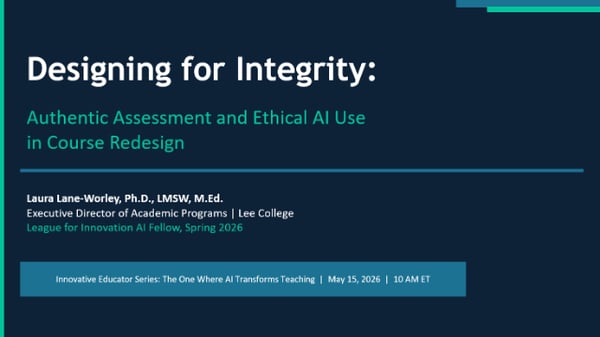
Designing for Integrity: Authentic Assessment and Ethical AI Use in Course Redesign
Laura Lane-Worley, Ph.D., LMSW, M.Ed. – Lee College
When over half of student submissions showed substantial AI-generated content, rather than agonizing over AI detection with false positives, the instructor turned to course redesign. This session explores the complete overhaul of an Introductory Sociology course at a Houston-area community college, driven by a simple premise: if students are going to use AI, teach them to do it honestly and critically. Participants will see how a course of 19 assignments was restructured into thirteen high-impact, AI-resistant assessments — including interview-based projects, community observation fieldwork, and a transparent AI research portfolio. The result: reduced grading load, stronger academic integrity, and students who leave the course as informed, ethical consumers of AI tools.
Key Takeaways:
- Discover how redesigning for authenticity — rather than AI-proofing — produces assessments students can't outsource and won't want to.
- Learn a practical framework for embedding ethical AI use directly into course assignments as a transferable digital literacy skill.
- Gain strategies for streamlining course structure to reduce grading load while increasing student engagement and academic integrity.
Speakers




Slides (2)