

Inside Blackboard
July 22, 2026
Teach, Reach, and Demonstrate: Recapping the Highlights from Building Blackboard Together ’26
# Building Blackboard Together
# LMS
# Accessibility
# AI
Building Blackboard Together
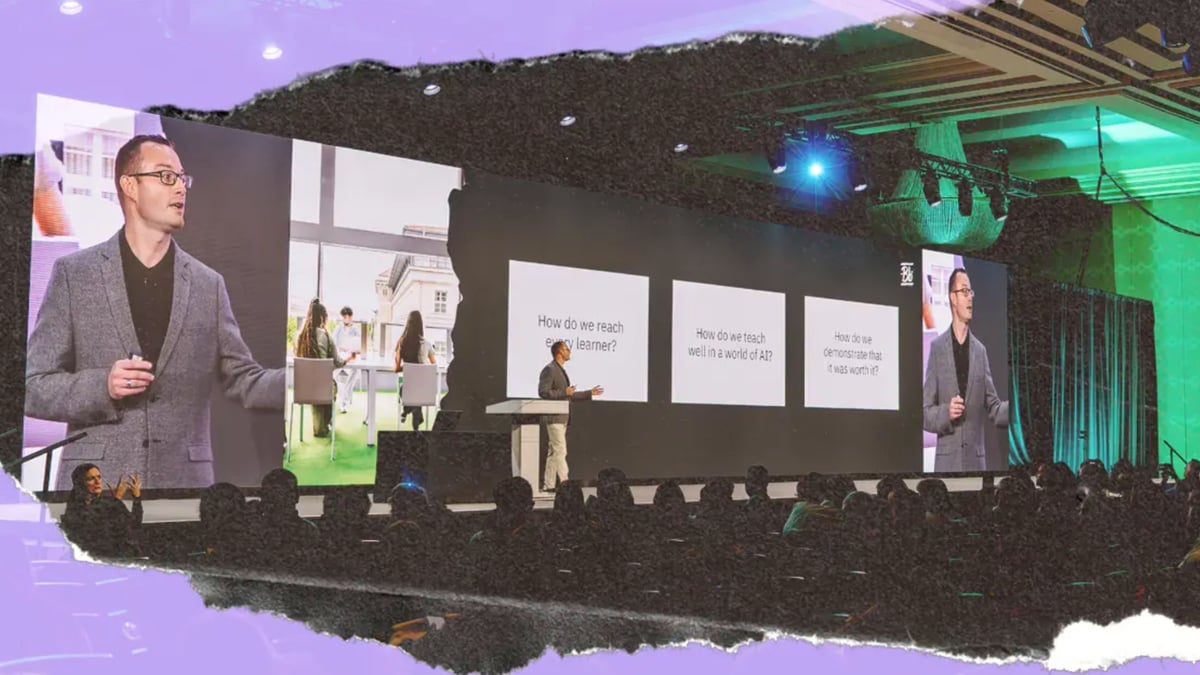
The global Blackboard community descended on Dallas last week, energized by a renewed focus on teaching and learning in the AI era. Building Blackboard Together assembled a diverse group of professionals from more than twenty nations, including leaders from the higher education, corporate, government, and K-12 sectors. The 1+ million instructors that use Blackboard every month were well represented, including accessibility experts that have leveraged Blackboard Ally to process 450+ million content items in the past year and Institutional Effectiveness partners who have used our solutions to improve the learner journey of more than 3 million students. And, of course, the Blackboard team was also on hand, resplendent in the colors of our new brand .
As always with Blackboard, the product innovations presented were developed in collaboration with those in the audience. Kelly Hermann, VP of Accessibility and Student Affairs at the University of Phoenix, joined the keynote session to reflect on her experience of working with the Blackboard Product team, and how much her institution values the opportunity to participate in the development process. “It’s impressive to see all the suggestions in the Blackboard Idea Exchange, and particularly all those that have already been implemented,” she noted.

Trust is also fundamental to the relationship we share with our institutional partners, starting with an unyielding commitment to security. Dominic Gore, Blackboard’s EVP of Product Management, outlined how security and privacy are core considerations through our product development process, complementing credentials like DoD IL4 which are unique to Blackboard in the LMS market. Trust is also built upon high-quality support, and institutions were excited by the responsive, AI-powered support model that we’ll be rolling out in the coming months.
Gore introduced a simple framework to outline the latest innovations in our solutions: reach, teach, and demonstrate. In brief, reach is about creating a learning environment that responds to the needs of all students; teach empowers faculty to deliver engaging courses that students love to participate in; and demonstrate promotes the value of learning beyond a simple grade or number.
The reach pillar begins with our dedication to usability , which has already manifested in a revamped course experience in the first half of 2026. Only by truly understanding user behavior can we create a learning platform that reaches students from all backgrounds, and Blackboard is committed to developing our solutions accordingly. Accessibility is, of course, an essential component of this approach, and the unveiling of PDF Auto Tagging in Blackboard Ally received one of the conference’s loudest cheers.
Continued AI innovation is at the heart of the teach part of the framework. As detailed by Carolyn Speer, Director of the Office of Instructional Resources at Wichita State University, recent Blackboard capabilities like the AI Conversation have helped institutions shift the focus from product to process.
And we’re not stopping. In the coming months, we’ll be adding further AI-powered activities to Blackboard LMS, including flashcards and a new Pulse Quiz task within the AI Conversation . We’ll also be collaborating with institutions to develop Scholar by Blackboard, an AI-era personalized studying tool that helps students see what to do next and gives them the tools to learn more effectively.
Moving to the demonstrate phase, this starts with an intuitive grading experience for instructors. A year-long feedback process with faculty from around the world has directly informed an updated gradebook in Blackboard LMS. Demonstrating outcomes also requires a shift in how think about the value of learning—a move from the product to the process, as Carolyn Speer noted above— and insights from our Future of Assessment Working Group have been essential to our development of AI-powered, formative feedback in the LMS, to be released in the coming months.
Focusing on the process of creation vs. evaluating the assignment is a crucial shift for academic integrity, also. We’re pleased to announce the launch of Cursive by Blackboard , which goes beyond traditional detection models to verify the authenticity of student’s writing. Cursive sits with the writer—from the first keystroke to submission—and builds a real process record alongside the work: drafting, editing, revision, effort. It runs on-device, so it isn't chasing whatever generation tool happens to be popular this semester. It gives faculty something to actually review instead of a score to argue about. And it follows the work wherever else your learners actually do it.
“We are moving away from the whole notion of policing AI — of accusation and detection — and toward verifying authorship.”Dominic GoreEVP of Product Management, Blackboard
Finally, Building Blackboard Together allowed our community insight into the future of learning technology, highlighted by a fireside chat with Blackboard founder and incoming CEO, Matt Pittinsky. Alongside leaders from University of Phoenix, San Jacinto College, and Boston University, Pittinsky expanded on his LMS at 30 vision , wherein platforms shift to orient around the learner rather than course. An AI-powered evolution of assessment practices, refocused on learning outcomes, is a core component of this approach.
To learn more about how teach, reach, and demonstrate applies in individual solutions, register for upcoming roadmap webinars for Blackboard LMS and Blackboard Ally today!
FAQs
What is Building Blackboard Together?
Blackboard’s annual user conference. The 2026 edition took place in Dallas, Texas, with three action-packed days of discussions around learning technology, assessment, AI, accessibility, and much more. We’ll be releasing more content from the event in the coming weeks.
What new AI features were announced for Blackboard LMS?
We announced great AI additions to our market-leading learning management system. These include a new flashcards activity, a pulse quiz in the AI Conversation, and formative feedback based on the grading rubric. Register for the Blackboard Roadmap Webinar to learn more about these capabilities.
How does Blackboard use AI to improve teaching and learning?
Blackboard LMS has AI-powered features for several crucial functions. The AI Design Assistant provides efficiency for instructors, providing them with suggestions to inspire module, content, assessment, and rubric creation.
The AI Conversation and our premium AI offering, AVA, build off this base of efficiency to improve learning effectiveness. This involves practical, real-world tasks that integrate AI into assessment, preparing students for the modern workforce.
What is Cursive by Blackboard?
Cursive by Blackboard is a new tool that institutions can use to promote authenticity in student work. Rather than applying a blocking or detection approach, which have shown inaccuracies and bias, Cursive takes an authorship-first approach to writing that provides visibility and fairness for students, instructors, and institutions alike.
How does Blackboard support academic integrity?
As well as Cursive, Blackboard supports academic integrity by working with institutions to advance evolved pedagogical approaches for the AI-era. We have two upcoming whitepapers in this area— one on feedback , the other on assessment design —use the links to register to get your copy on the day of release.
How does Blackboard improve accessibility for students?
Accessibility is fundamental to the development of all our teaching and learning solutions. Each new feature that is developed is tested rigorously for accessibility and designed to help users of all backgrounds. Learn more about our approach to accessible design here .
Blackboard Ally , our market-leading accessibility tool, is a core part of this. More than 1500 institutions around the world use Ally to fuel their accessibility approach, driving accessible content at scale while instilling positive behaviors with instructors. To learn more about the new features coming to the platform, register for the upcoming Ally Roadmap Webinar .
What are Blackboard's latest LMS updates?
We announced a ton of updates in Blackboard LMS at Building Blackboard Together. Users are very excited for the new content editor, revamped gradebook, AI innovations, and other new features that will be in production in the coming months.
What is the Reach, Teach, and Demonstrate framework?
This is Blackboard’s holistic view of the role of learning technology in modern education. Institutions need learning software that can reach diverse groups of students, can help instructors to teach in an engaging and purposeful way, and can demonstrate genuine progress in learning understanding. At Blackboard, we’re developing our portfolio of solutions to help institutions in each of these three areas.
Comments (0)
Popular

Dive in
Related
Blog
Highlights from the Western Region Ally User Group Meeting
By Katie Grennell, PhD. • Jun 22nd, 2026 • Views 134
Blog
The Power of Together: Connecting Faculty and Advisors with Integrated Student Alerts
By Juan Lopez • Jul 21st, 2025 • Views 151
Blog
Highlights from the Western Region Ally User Group Meeting
By Katie Grennell, PhD. • Jun 22nd, 2026 • Views 134
Blog
The Power of Together: Connecting Faculty and Advisors with Integrated Student Alerts
By Juan Lopez • Jul 21st, 2025 • Views 151