

Thought Leadership
May 7, 2026
Books without Barriers

# Ally
# Accessibility
A Disability History of the United States

Katie Grennell, PhD.
Books without Barriers: A Disability History of the United States
This post is the second installment in the Books Without Barriers blog series, which highlights texts that deepen our understanding of access, equity, and the lived experiences of disabled people. While the first post set the stage for reclaiming the meaning of disability, this entry turns to a foundational text in disability history: Kim E. Nielsen’s A Disability History of the United States.
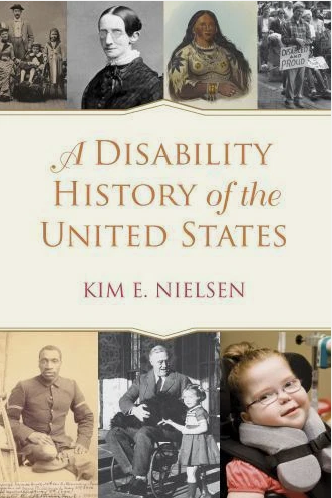
Image description: Book cover of A Disability History of the United States by Kim E. Nielsen, with the title centered on a beige background. Surrounding the title are historical and contemporary images of disabled people, including portraits, a protest scene, and archival photographs.
As a history instructor and academic, I would be remiss if I skipped over the importance of historical context in conversations about accessibility and inclusion. History is not just background, it shapes the systems, assumptions, and inequities we navigate today. The ways disability has been defined, treated, and politicized over time continue to inform everything from public policy to cultural attitudes. If we want to understand the present, and more importantly, work toward a more accessible future, we have to grapple with the past. Nielsen’s book provides that essential context by placing disability at the center of U.S. history rather than in the margins.
A Disability History of the United States traces how disability has been defined and traced from pre-colonial America to the present. Nielsen shows that Indigenous communities often took more relational approaches to disability, while European colonization introduced stricter ideas about productivity and bodily “fitness.”
As the U.S. industrialized, disability became increasingly tied to labor and economic value. Those who did not meet norms of productivity were often institutionalized or excluded. Disability was also used to reinforce other systems of inequality, demonstrating how ableism intersects with racism, sexism, and immigration restriction to produce layered forms of exclusion.
The early 20th century saw the rise of eugenics and forced sterilization, disproportionately targeting disabled people. But Nielsen also emphasizes resistance, particularly in the mid-to-late 20th century, when disabled activists pushed for rights, accessibility, and inclusion, leading to major legislation like the Rehabilitation Act of 1973 and the Americans with Disabilities Act in 1990.
Like most history, the history Nielsen presents in her text is dark and difficult to stomach. From the Ugly Laws to the eugenics movement and forced sterilization, these are not distant or abstract harms. But we cannot turn away from that discomfort. These histories have directly shaped how disability is understood, perceived, and addressed in the United States, influencing everything from cultural attitudes to legislation and public policy. There’s no dismantling these barriers without first confronting the history that built them.
For a series like Books Without Barriers, this text is foundational. It reminds us that the barriers we work to dismantle today are historically constructed, and that history will keep repeating these harms unless we consciously and collectively decide to disrupt them.
Comment (1)
Popular

Popular
Dive in