

Thought Leadership
May 5, 2026
Books without Barriers

# Accessibility
# Ally
Claiming Disability

Katie Grennell, PhD.
Books without Barriers: Claiming Disability
Books Without Barriers is a limited blog series published exclusively during the month of May in honor of Global Accessibility Awareness Day (GAAD). Throughout the month of May, this series will highlight influential books for adult readers that explore disability history, accessibility, inclusive and accessible design, inclusive course design, and lived experience, spanning genres such as nonfiction, memoir, fiction, and narrative storytelling.
Like most things, this blog series is deeply personal for me. I fought being disabled for much of my life. In retrospect, it was the label that I struggled with the most and the social implications that came with it. It wasn’t until I discovered disability studies as an academic discipline in graduate school that I began to recognize this fight for what it was-internalized ableism. My acceptance of my disabled identity and understanding of disability as a social construct did not happen overnight, it is still ongoing. But this discovery of a whole new world of books and theories and history quite literally changed my life.
Just as Fräulein Maria encouraged the von Trapp children to “start at the very beginning, a very good place to start” when learning how to sing, I’m beginning this series where my own journey really started—with Claiming Disability: Knowledge and Identity by Simi Linton. Widely considered a foundational text in disability studies, Claiming Disability centers on Linton’s critique of the medical mode of disability, where she argues that “the medicalization of disability casts human variation as deviance from the norm, as pathological condition, as deficit, and significantly, as an individual burden and personal tragedy.”1 This framing, she suggests, limits how disability is understood and reinforces stigma by placing the “problem” within the individual rather than within inaccessible systems and environments. By challenging this perspective, Linton opens the door to a more expansive and human-centered understanding of disability that is grounded in empathy and a keen awareness of language, power, and social context.
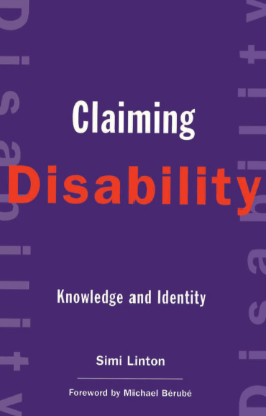
Image description: The image is a cover of a book titled Claiming Disability: Knowledge and Identity by Simi Linton. The background is a solid purple color. The title is prominently displayed in the center, with the word "Claiming" in white and "Disability" in bright orange. Beneath the title, the subtitle "Knowledge and Identity" appears in white. The author's name, Simi Linton, is located below the subtitle in white text. At the bottom, it states "Foreword by Michael Bérubé" in white. The word "Disability" is repeatedly printed vertically in a lighter shade of purple along the left and right edges of the cover.
As we recognize Global Accessibility Awareness Day, it feels especially fitting to begin this series with this particular book. Before we can meaningfully design for access, we have to understand the frameworks that have historically limited it. Linton challenges us to rethink disability not as deficit, but as identity, pushing us to confront the “-isms,” labels, and social constructs that shape our perceptions and systems. Just as importantly, she does so in writing that is remarkably accessible—clear, engaging, and inviting in a way that academic texts so often are not. That accessibility is not incidental; it models the very principles this day calls us to embrace.
When I first encountered Linton’s work, I didn’t yet have the language to describe what felt so profound about it, only a growing sense that it was naming something I had only just begun circling. Her framing of disability as a cultural and political identity, rather than simply a medical condition, shifted how I understood not only the world around me, but how I saw myself in it. In many ways, this book marks the start of my journey, a formative one that continues to evolve, but that I return to often as a point of grounding and clarity.
Ultimately, Claiming Disability is both an introduction and a call to action. It asks readers to rethink what disability means, to recognize the limitations of purely medical perspectives, and to engage with disability as a site of identity, resistance, and belonging. For many, it serves as an entry point into a broader conversation, one that continues to evolve, but that Linton helped to define with clarity and conviction. Engaging with Claiming Disability can be one way to honor Global Accessibility Awareness Day, offering space to deepen awareness, reconsider assumptions, and reflect on how understanding can translate into action.
References
1. Simi Linton. Claiming Disability: Knowledge and Identity. (London, New York: New York University Press, 1998), 9.
Comments (0)
Popular

Popular
Dive in
Related
External Content
Turning Title II Into Meaningful Change: A Framework for LMS Accessibility
Mar 27th, 2026 • Views 33
External Content
Turning Title II Into Meaningful Change: A Framework for LMS Accessibility
Mar 27th, 2026 • Views 33